|
|
|
|
| |
| Welcome to Junior Kidz |
|
|
|
|
|
|
Your toddler is developing at a mighty rate gaining new physical, cognitive, and emotional skills every day. In the next five years, you’ll watch him go from tantative toddler who speaks only a few words to a confident preschooler with a growing awareness of the world around him.
Each child is unique and reaches developmental milestones at his own pace
Early child hood from your baby’s birth until he or she turns 5, is when children develop skills they will use for the rest of their lives.
The normal growth of children can be broken down into the following order |
|
| Gross Motor |
: |
controlling the head, sitting and walking, holding spoon, picking |
|
|
up a piece of cereal between thumb and finger. |
|
|
|
| Sensory |
: |
seeing, hearing, tasting, touching and smelling. |
|
|
|
| Language |
: |
being able to talk and be understood, and understanding what |
|
|
parents and other children say. |
|
|
|
| Social |
: |
the ability to play with family members and other children. |
|
|
| At 18 Months |
|
| At this stage you can expect your child to walk backwards, walk up steps with their hand held, kick a ball, say 10 to 25 words, name 3 body parts, turn pages of a book and stack two blocks together. Over the next few months your child will learn new words, start to throw a ball overhand, use two word combinations, and remove clothing. This is also a time that your child will begin to explore and try and figure out how things work and will enjoy playtime. It is important to give lots of praise and many opportunities for exploration. If using a pacifier, it is a good time to start restricting its use to only when your baby is in his crib, so that his interest in it will decrease. |
|
| At 2 Years |
|
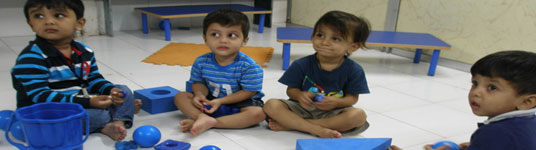
| At this age you can expect your child to put on clothing, brush his teeth with help, stack 4-6 blocks, combine words, know over 50 words, use pronouns(I, me, you, mine), follow two steps commands, know his body parts, walk up steps, kick a ball, jump up, throw a ball overhead, and his speech should be half understandable, Over the next years his speech will become more understandable, and he will be able to name pictures and colors, If using a pacifier, it is good time to start restricting its use to only when your baby is in his crib, so that his interest in it will decrease. He may begin to play around other children, but it will be parallel play. Children at this age are very self centered and may play alongside each other, but it will be some time before they actually start playing together. Your child will probably not want to share his things and he may be very possessive. It is important to closely supervise children that are playing together at this age and reassure them that the other child will not keep his toys. Keep a few of his favorite items separate and not available for sharing so that he feels he has some control over things. |
|
| At 3 years |
|
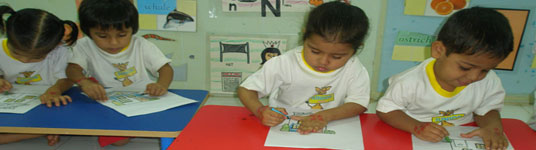
| At this age your child is becoming more independent and you can expect him to dress himself and button clothes, brush his teeth with help, stack 9-10 blocks, draw circles and squares, use scissors, walk up steps by alternating his feet, jump from a step, hop, walk on his toes, pedal a tricycle, play with imaginary friends, have a very large vocabulary and use 3-4 word sentences and his speech should be 3/4 understandable..Over the next year his speech will become fully understandable. Your child will now begin to ask why questions, tell stories, remember nursery rhymes, appreciate special events, and understand daily routines. Your three year old will now begin to play cooperatively with other children in small groups share his toys and develop friendships. Playtime will include structured games and fantasy activities. |
|
|
|
Programs for Babies |
|
|
Programs for Toddlers |
|
|
| |
|
|
Programs for School-Age Childern |
|
|
|
|
|
|
|
|
|